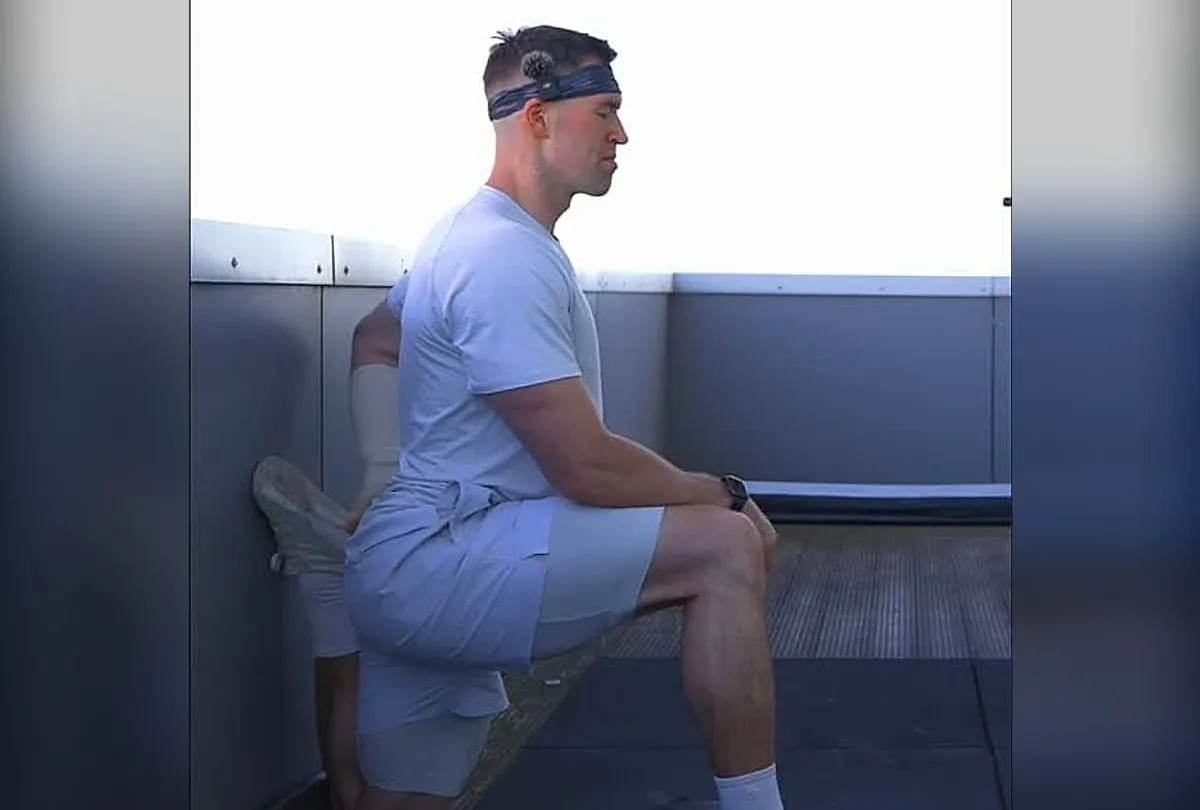
Hip Mobility Exercises: The 90/90, the Cossack Squat and How to Dose Them
Jasper MacDermot builds hip mobility with a rotation drill you can do every day and loaded work in the directions you most need. The 90/90 is a hold followed by contractions, and his loaded drills use five to ten slow reps with a hold at the deepest position.
In this article
- Which hip drills make the biggest difference?
- What do people get wrong about tight hips?
- How do you use the 90/90 for hip internal rotation?
- How long does it take to get comfortable in a 90/90?
- Where do the Cossack squat and Copenhagen plank fit?
- How many reps for hip mobility drills?
- Will better hip mobility improve your squat and deadlift?
- When should hip pain stop your training?
- Which hip drill should you start with?
Which hip drills make the biggest difference?
Jasper MacDermot’s hip mobility exercises start with one rotation drill you can do every day, with no equipment. He then loads the two directions a client most needs. Usually that’s a wide stance for the inner thigh and hip extension for the front of the hip.
If we think about which hip drills I would give a new client, it would be wrong to say “these ones”, because everybody’s going to be slightly different. But we can think about buckets.
- Rotation: We definitely want a rotation drill, something that stirs the head of that femur (the thighbone) in that pelvis every which way you can. You don’t need anything. Set them up standing, lying on your side, on all fours, kneeling. You can do those every day.
- Flexion: The thigh comes up towards your chest, like you’re doing a hanging knee tuck, or trying to sit in a deep squat.
- Out to the side: You take a wide stance, where you feel the adductor (inner thigh) in the groin get tight. That’s where most people don’t train. Cossack squats, lateral lunges, lateral squats and adductor sliders sit here.
- Hip extension: You take the leg back behind you. That’s going to involve that hip flexor (front of the hip) getting more comfortable in a lengthened (stretched) position, and stronger there.
I pick the two directions of movement for that hip that you want to get better at. For me that’s typically the wide stance, and hip extension. That will make just about everything you do feel really good.
What do people get wrong about tight hips?
Most people try to stretch tight hips away. Jasper keeps the stretch and makes it progressively harder. Then he loads the hip so it gets strong in all the different directions.
Typically the thinking is, let’s stretch it away. You put yourself into a pseudo pigeon position, or some kind of floor stretch, yoga stretch, or wall stretch with your foot up against the wall.
That can feel good, and that’s definitely part of the puzzle. But just trying to stretch it away is leaving a lot on the table.
You throw five to ten minutes a day of stretching in there. It might feel better, but you return to the same point the next day.
So for tight hips, I would say let’s load it.
We’ve got the stretch component in there, so we’re lengthening the tissue in whichever direction we are trying to target. But can we then also contract that? Can we get strong in all the different directions?
And when I say loading it, I mean even your own body weight is load. You control it through a range of motion.
Mobility vs flexibility covers loading the front of the hip in its stretched position.
Strengthen the hip flexor with the knee up
For tight hips, we also want to strengthen the hip flexor in its shortened position, with the knee drawn up. That might be the bit that people get wrong.
So can we bring the leg up towards our chest? You can load that up with dumbbells, cables, bands, whatever you want to do. Even use gravity by hanging from something, and then holding or doing reps of pulling that leg into your front.
How you go about doing that is up to your imagination really. There’s a million ways that you can set up different exercises and drills, but the principle remains the same. Strengthen it in every direction, using holds, sets, reps, added weight. So that would be the main thing.
Make the stretch progressively harder
Don’t leave the strengthening component on the table. Yes, stretch it. But stretch it in a progressively challenging way to you.
That will make you engage more, because you’ll see “wow, I’m better here than I was two weeks ago”. Then also make sure you are strengthening it through a full range of motion.
How do you use the 90/90 for hip internal rotation?
In the 90/90 you sit on the floor with both knees bent to about 90 degrees, one hip turned out (external rotation) and the other turned in (internal rotation). Jasper MacDermot’s clients hold it for 60 to 120 seconds, then add contractions.
You’ll see that 90/90 position planted everywhere. It’s typically because it’s the most lo-fi way of asking, okay, can we get the hip into an external and internal rotated position? We don’t need any equipment. We can sit on the floor and see how we’re looking.
Scale it to your start position
How comfortable you are in the 90/90 depends, as annoying as it is. Everybody’s start position is different. I do use it as a drill plenty. The way we’ll scale it is torso angle in relation to the hips, meaning how far you lean.
Try using different tools, like a yoga block, or using the hands to find a position that doesn’t lock you up or make you panic.
That sort of nervous system panic is a protective mechanism. It will then largely stop you from doing productive work, even if it feels like a good intense stretch. Like anything, it’s finding the right entry point.
Hold it, then contract
Holding a conventional stretch like the 90/90 is a great way to start building the tolerance in that position. So we will hang out there for 60, 90 or 120 seconds.
On top of that we look to perform some contractions, driving that lower leg into the floor. Whether it’s the internally rotated hip or the externally rotated hip, you’re contracting hard in different directions without moving.
In Functional Range Conditioning (FRC) terms, we would call this PAILs and RAILs. They are hard contractions held at a fixed angle.
That helps to build both range and tolerance, because you’re essentially producing force in positions that you’d otherwise probably stretch.
From there, the world’s your oyster. You can hang out in the same position for longer, or try rotating in and out, different drills and different setups. It depends on your equipment, what you have access to, your know-how, and how to get into effective positions for your body.
How long does it take to get comfortable in a 90/90?
Jasper’s clients usually spend the first couple of weeks getting used to the 90/90. From about two to six weeks, he starts building up passive holds.
That first couple of weeks in the 90/90 is tolerance more than anything, mentally and nervous system wise. We’re not getting a lot of changes at the tissue level.
Then at that two to six week marker, we can start building up the holds, if we’re doing passive holds, where you relax into the stretch.
Where do the Cossack squat and Copenhagen plank fit?
Jasper MacDermot’s inner-thigh work starts with a hold, like the Copenhagen plank, then adds movement with the Cossack squat.
Definitely most clients will have something in there for the adductors, because that is going to be underexposed.
If you have a sport or something more dynamic that you do, the groin is often an under-trained area. So people can stand to gain a lot by training anything that challenges that adductor.
As Jasper puts it, you strengthen the adductor in its shortened position. You can do Copenhagen planks (a side plank with your top leg supported), or anything that holds that in place.
We can then make it dynamic with a Cossack squat, a deep side-to-side squat in a wide stance. Or you can do some sort of wide side split, something that slides that leg in and out, or steps it in and out.
How many reps for hip mobility drills?
Five to ten slow repetitions is Jasper’s usual range, with a hold at the deepest position.
Sets and reps follow conventional stuff. I tend to keep things anywhere from five to ten repetitions. End range holds, pausing at your deepest position, are going to be an important part, so how you do that rep is going to account for a lot.
Say it’s six reps a side. We’re going to do those six reps with a three to five second lowering phase. Then we’re going to hold your deepest position for anywhere from two to five seconds.
That slow rep and hold help strengthen the hip in that lengthened position. It also gives you that big uptick in the nervous system response. You’re going to feel so much better by owning that space.
Performing what is essentially an isometric contraction (holding still under tension) in what feels like the most uncomfortable place is a huge rock on the table. You can grab it with every rep. You don’t need to do anything else. You need to focus on making those reps as meaningful as you can.
| Drill | How he uses it | What it trains |
|---|---|---|
| Hip rotation drill | Can be done every day, no equipment | Rotation in every direction |
| 90/90 hold, then contractions | 60 to 120 seconds | Internal and external rotation |
| Copenhagen plank, then Cossack squat or lateral lunge | Hold first, then move the leg in and out | The inner thigh |
| Loaded drills for reps | 5 to 10 reps, 3 to 5 seconds down, 2 to 5 second hold | Strength at the deepest position |
Will better hip mobility improve your squat and deadlift?
In Jasper MacDermot’s experience, yes. A client whose squat or deadlift changed once their hips moved better “is everyone’s”, he says, though everyone starts from a different position. He runs hip work alongside the lifts, because it pays off more slowly.
Improving the squat or the deadlift is understandably what most of us are going to be interested in. That’s where hip work does involve an element of trust.
You’re trusting that the work you’re doing is going to pay off down the line, because it won’t be as immediate an improvement as more conventional methods of training.
That’s why I like the hip work and the lifting to run parallel together, so you can get the best of both worlds.
Scale the lift
Keep doing your squats and deadlifts. Don’t gate movement patterns (hold back a lift) until you’ve reached some arbitrary standard. I don’t think that’s the way to do it.
I would always scale a movement, and make adjustments so that a client can safely, confidently and productively interact with that movement. We’re still loading those tissues in a squat or a deadlift, whether we have to raise the bar or raise the heels.
And then running parallel to that, we will dig deeper to the joints involved. Typically that is going to be the hips, for a squat or deadlift. And so then we can open up our movement options over time.
It’s a nice two-pronged approach to progression. You’re increasing your loading performance, meaning sets, reps and weights. And you’re also seeing mobility improvements, which can feel a little intangible. So it helps to have some measurables in place.
I could name you plenty, client A, B, C, all of which had a slightly different start position, and with all of them we follow the same protocol.
What can we safely do right now to start levelling us up, getting us stronger, building muscle, getting meaningful tension through those tissues? We’re not spending the entirety of our session doing abstract mobility drills. Find the right dose, let them run in parallel.
One client’s story
One client I see four times a week was a very consistent trainee with a trainer for years before we met.
We kept working the range in his hips alongside the conventional lifting. He’s got stronger than ever, and now he can start looking at single leg squats or Cossack squats.
What clients notice first
Early on, clients often tell me things like, “usually after a squat session I wake up the next day, my back hurts”.
What do I notice first? It’s typically feedback like “I just feel better”, or “oh wow, I can sit down comfortably here, and this feels better”.
Over time, we are able to better distribute those forces through the body and lift more efficiently. We’re going to notice less compensation (other areas taking over). So then the back doesn’t get loaded up as much, perhaps.
Retesting every six weeks
We come to retest every six weeks or so, if we’re picking an arbitrary number.
How are positions feeling? Can we try lowering that start position on the bar? Can we try lowering our depth on the squat to a lower box, or removing heel elevation? Whatever it is that we’re particularly trying to focus on, provided that is of interest to the client.
And then we continue to level up, open up movement options and different variations, and you sort of lift the veil. I’ve seen so many people have those aha moments, like “I’ve been training so long and I could never sit in a deep squat. I would never feel confident doing this variation”.
When should hip pain stop your training?
A pinching or sharp pain at a joint is when Jasper MacDermot refers someone to a physiotherapist, so they can look if there’s something more acute. Short of that, he works around discomfort and avoids anything that crosses a three out of ten pain threshold.
We can obviously work sensibly around discomfort, because everyone’s going to have some discomforts. It’s not going to feel great. But there’s a big difference between that and then a sharp pain, which tells us “hey, no, no, no, no”. So that is absolutely when I would refer someone to the physio.
Otherwise the workflow typically remains the same. What level can you engage at? How can we strengthen whatever’s going on there, and lower that sensitivity? Because not doing anything is very seldom the solution.
The NHS advises seeing a GP if hip pain stops normal activities or affects your sleep, gets worse or keeps coming back.
Ask for an urgent GP appointment or call 111 if your hip is swollen and hot, or you have hip pain with a high temperature and feel unwell. Severe hip pain after a fall or injury, or being unable to put weight on your leg, needs 999 or A&E.
Jasper’s mobility coaching waits for a clinician’s clearance after surgery in the last eight weeks, an acute joint injury, a recent dislocation, or acute joint pain no clinician has assessed.
Which hip drill should you start with?
Jasper MacDermot’s starting point is a rotation drill you can do every day, then slow, loaded work in a wide stance and in hip extension.
Jasper programmes this into strength sessions at UNTIL Liverpool Street, starting with an assessment. See his mobility and flexibility coaching.
Frequently asked questions
How should you dose hip mobility drills?
Jasper MacDermot's usual dose is five to ten slow reps, lowering over three to five seconds, with a short hold at the deepest point. He also wants a hip rotation drill in every new client's programme, one that needs no equipment and can be done every day.
Why is the 90/90 used for hip internal rotation?
The 90/90 puts one hip into internal rotation and the other into external rotation. Jasper MacDermot says it's used everywhere because it's the most lo-fi way to check both, with no equipment. He uses it as a regular drill, with holds of 60 to 120 seconds and then contractions.
Why do my hips feel tight again the day after stretching?
Most people try to stretch tight hips away, says Jasper MacDermot. Five to ten minutes a day might feel better, but you return to the same point the next day. Stretching alone leaves a lot on the table, he says. He makes the stretch progressively harder and the hip strong in every direction.
Can you keep squatting while you work on hip mobility?
Yes. Jasper MacDermot doesn't make clients wait for some arbitrary standard before they squat or deadlift. He scales the lift, raising the bar or the heels, and runs hip work alongside it. About every six weeks he retests and tries to lower the bar or the heels again.
Should you train through hip pain?
Jasper MacDermot works around discomfort up to about three out of ten, and refers pinching or sharp joint pain to a physio. The NHS advises a GP if hip pain stops normal activities or affects sleep, is getting worse or keeps coming back, and 999 or A&E for severe pain after a fall or injury.